柿子产业发展现状及高质量发展路径研究

打开文本图片集
中图分类号:F320 文献标识码:A 文章编号:2095-5553(2026)03-0268-08
DOI:10.13733/j.jcam.issn.2095-5553.2026.03.036
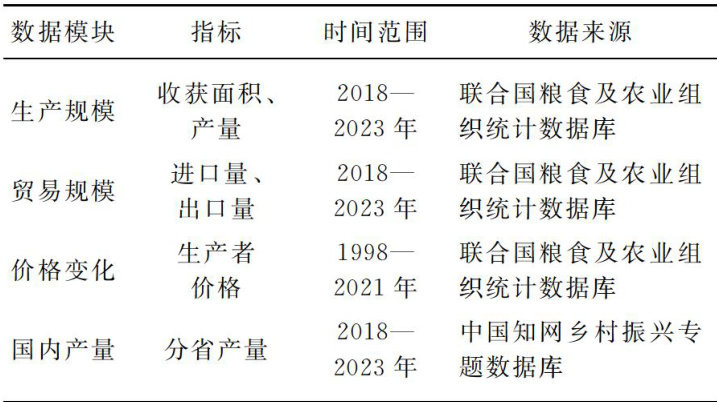
Abstract:High-qualitydevelopmentofspecialtyfruitindustriesunderChina’srural revitalizationagendarequires that growth paterns,supply-chain capacity,and market volatility be better aligned.Drawing on harvested area,output, tradequantities,andproducer pricedata from theFAO statistical database,together withnational and province-level persimmon output series from theCNKIRural Revitalization Thematic Database,this study uses 2O18—2023 as the main observation window to examine changes in production scale,spatial concentration,and trade dynamics in China’s persimmon industry,andcharacterizeslonger-run price fluctuationsusingthel998—2021 producer price series. Results show that output increased by about 26.7% and harvested area by about 25.4% over 2018—2023,while yield declined by about 3.8% ,indicating that recent expansion has been driven primarily by area growth rather than yield gains.On the trade side,exportsincreased overall but displayedpronounced interannual volatility,wereas importsremainednegligible;netexportscloselytracked exports,suggestingarising outward orientation while domesticdemand continues toabsorb most production.Spatial concentrationstrengthened,with Guangxi accounting forroughly 37.1% of national output in 2O23 and the top five provinces together contributing about 75.4% .These findingsunderscore theneed for whole-chain upgrading,including stronger standardsand qualityconsistency,improved postharvestcommercializationand cold-chainaggregation capacity,enhanced standardizedprocesing toabsorb seasonal supply,and coordinated development of branding and marketing channels. Keywords:persimmon;value chain;spatial concentration;trade;high-quality development
0 引言
柿子是我国重要的特色果品之一,适应性强,在丘陵山地与旱作区具有较好的栽培适配度,兼具鲜食消费与加工利用两类市场形态[1-4]。(剩余13490字)