赖草幼苗根系表型可塑性对盐胁迫的适应性响应

打开文本图片集
中图分类号:S812 文献标识码:A 文章编号:1007-0435(2026)04-1242-10
doi:10.11733/j.issn.1007-0435.2026.04.010
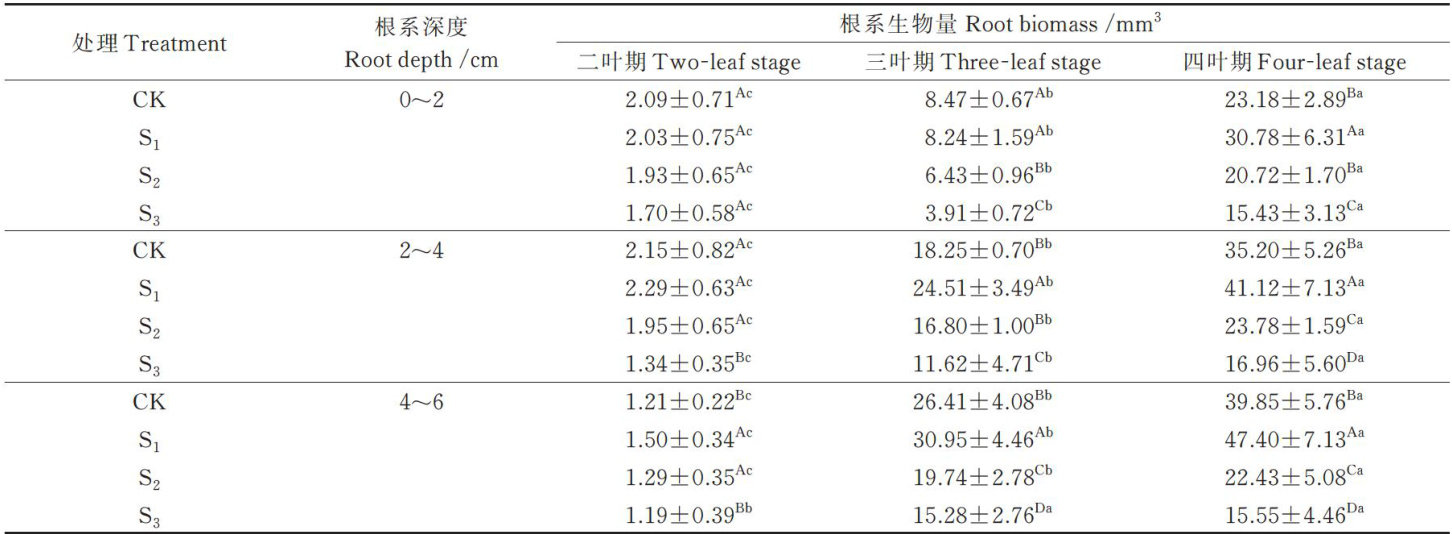
Abstract:The restoration of saline grasslands relies on effective soil amelioration,precise seeding timing,and succesful seedling establishment. In this study,the pioneer grass species Leymus secalinus was used as test material,and low,medium,and high salinity levels of salt stress were set up using a 1:2 ratio of NaCl and Na2SO4 . The effects of salt stress and its interaction with seedling age on root system phenotypic plasticity were investigated. Our results showed that salt stress made roots grow shalower. Seedling age Was the main factor controlling root biomass distribution ( P<0.001 ). Salt alone and its interaction with age were only significant in some cases. Salt and age both reduced root length, surface area,and volume ( ⋅P<0.01 ).Their interaction had the strongest effect on root volume ( F=36.878 .Salt damage increased nonlinearly asthe seedling grew. Root tip number decreased with higher salt. Older seedlings were more sensitive to salt. Root angle significantly reduced atthe two- and three-leaf stages.Also,root fractal dimension showed a nonlinear response,and increased under low salt but decreased under medium and high salt ( (P<0.05) .This study revealed the phased adaptation strategies ofLeymus secalinus seedlings under salt stress,providing a basis for enhancing the application potential of Leymus secalinus in ecological restoration of saline grasslands.
Key words:Leymus secalinus; Salt stress;Seedling age;Root system;Phenotypic plasticity
土壤盐渍化是影响全球草地生态系统健康的关键因素[1],尤其在干旱和半干旱区,土壤盐分累积导致草地退化、植被覆盖度下降,严重威胁生态安全[2-4]。(剩余19763字)