《张议潮统军出行图》乐舞及仪卫服饰形制及文化内涵

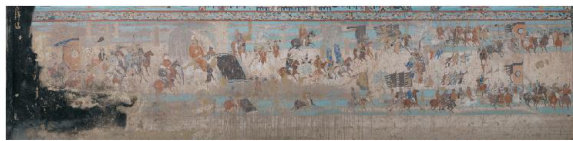
打开文本图片集
中图分类号:TS941.12;J509 文献标志码:A DOI:10.13338/j.issn.1006-8341.2025.05.013
AbstractTo gain a deeper understanding of the forms of music and dance performers and guard costumes during the late Tang dynasty,as wellas the manifestation of its diverse cultures,the performers of music and dance and guard costumes depicted in the painting Procession of Zhang Yichao Leading the Army of Cave156 at Mogao Grottoes were taken as the research object in this study.The method of material culture research was adopted,and combined with images and documents,the characteristics of shapes,misinterpretations of shapes,and cultural influences of the performers of music and dance and guard costumes in the painting were analyzed.The results show that the shapes of the performers of music and dance and guard costumes are clarifiedand corrected from the perspectives of identityand historical documents,and their shapesare mainly influenced bythe Central Plains and the ritual system.The patterns on the performers and guard costumes first appeared in the early Tang dynasty;in the late Tang dynasty,these paterns spread to the Western Regions driven by cultural integration.Their mainapplication scenariosare travel ritualsand oferings to Buddha,and the hierarchy of status is determined by the size of the patterns.The armors of the leading cavalry serve as a common carrier of the cultures of the Central Plains and Tubo.The performers and guard costumes are characterized by "taking the Tang system as the mainstayand integrating Hu and Han cultures",and the orthodoxy of the Central Plains is strengthened through such performers and costumes.This finding provides a theoretical reference for the study of cultural integration on the Silk Road.
Keywords Procession of Zhang Yichao Leading the Army;performers of music and dance costumes;guards costumes;costumes form
0 引言
莫高窟156窟是归义军首任节度使张议潮的功德窟,是结束统治敦煌之后莫高窟营建的新的里程碑式洞窟,主室南壁《张议潮统军出行图》是当时的真实写照,具有重要的研究意义。(剩余9891字)
