“空间,而非石材,是建筑的材料”
——理性主义建筑理念的开创者与教育家尼古拉·拉多夫斯基

打开文本图片集
Abstract:This paper examines the creativework and educational philosophyof spatial perceptionby Nikolai Radovsky,founderand educatorof the rationalist architectural movement.It explores the contributions to rationalist architectural theorymade by key figures of theNew Architects'Association (ASNOVA)- Nikolai Radovsky,Vladimir Klinsky,and El Lissitzky-with particular emphasis on the influence ofKazimir Malevich's Suprematist abstract painting and its theoretical underpinnings on rationalist spatial modelling and colour construction. It examines El Lissitzky's PROUN (Project for Unificationofthe Arts) theoryand methodology inadvancing rationalist architectural spatial form creation,whilst also analysing and comparing the similarities and differences between Constructivismand Rationalismwithin the Soviet avant-gardearchitectural movementof the1900s.
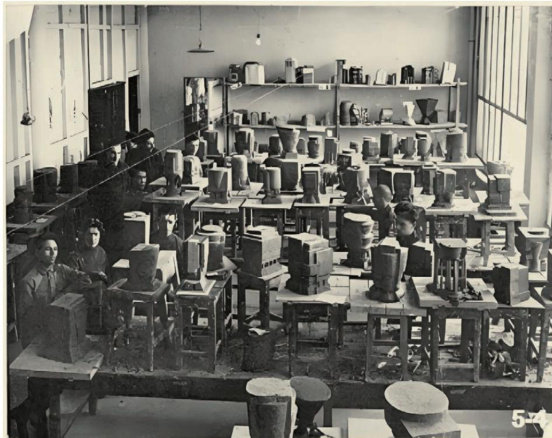
Nikolai Radovsky's“rationalist"architectural pedagogy gained significant traction in Khutema,whereasystematicanalysisof itscore characteristics-educational principlesofabstract spatial perception and formal composition alongside experimental training-proves crucial for comprehending rationalist architectural ideology.By examining the outcomesof the‘Space'course teachingsystem overmore thana decade in the 1920s,this paper discusses rationalist architectural pedagogy's exploration of spatial innovation,structural rationality,and perceptual experience inmodernarchitectural education,alongside Radovsky's educational innovations.Radovsky'sarchitectural teaching legacy isnot onlyreflected in nurturing numerous distinguished architects,but more significantly in his pioneering of aunique educational paradigm centred onspatial perceptionand formal experimentation,integratingscientific rationalitywith artistic creation.This paradigm exerteda sustained and profound influence on the construction of subsequent modern architectural education systems and the development of design thinking Itcontinues to hold significant historical referencevalueandacademic inspiration fortheoretical research and practical exploration within contemporaryarchitectural education.
Keywords:Nikolai Radovsky;Rationalism;Spatial Creation;Subjective Spatial Perception;Form Composition;Colour Construction;Architectural Form;Modern Architectural Education
前言
苏联前卫派建筑中的构成主义流派似乎描述了俄罗斯几乎全部的现代建筑探索,其核心组织“现代建筑师协会”(OSA)成立于1925年,但1923年成立的“新建筑师协会”(ASNOVA)却以其理性主义的研究而吸引了许多关注者,影响深远。(剩余18451字)
