造城实验:深圳城市设计制度化演变与建筑响应

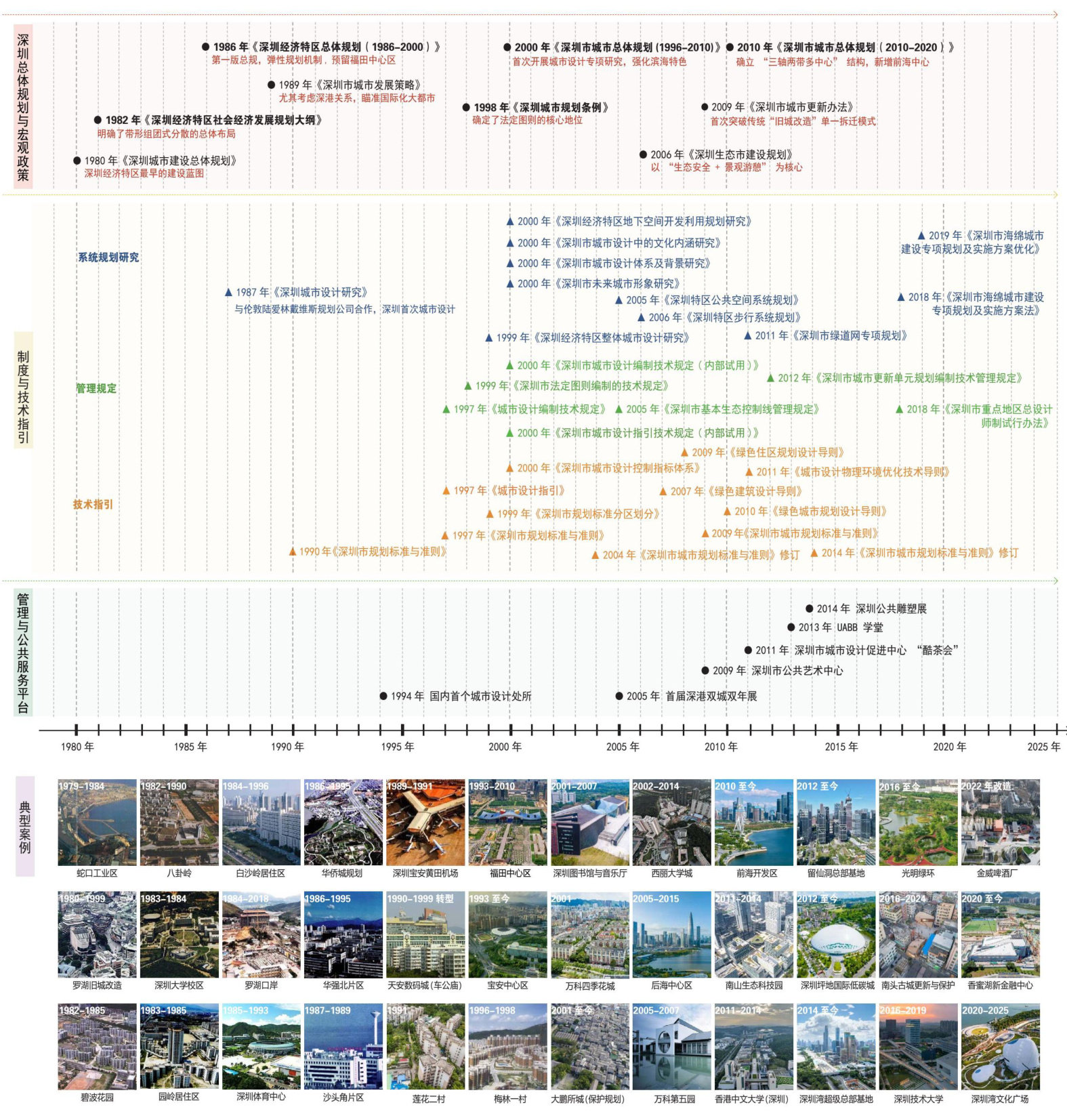
打开文本图片集
Abstract:This paper examines the evolutionary trajectory of the urban design system in the Shenzhen Special Economic Zone since the reformand opening-up and its interactive relationship with architectural practice.Grounded in the historical context of urban development, the research divides the evolution of Shenzhen's urban design into fourdistinct phases:the germination of conceptual frameworks and initial practiceofa holisticenvironmental perspective inthe1980s;the institutional establishment and formationof a spatial-form management framework in the 1990s; the refinement of management systems and theshifttoward public values in the 2ooOs;and the transition to stock optimization and integrated governance since the 2010s.By correlating representative eventsand architectural phenomena,the paperelucidates howShenzhen's urban design,through regulations,guidelines,and management processes,hasdevelopedan institutional systemthat progresses from morphological control to systemic governance. Concurrently,architectural design has responded to institutional constraints while continuously reshaping institutional connotations through practical innovations,thereby establishinga unique bidirectional transmission mechanism.This dynamic interactionreflects the coevolutionoftechnical rationalityand institutional rationality,aswell asthe intricate balance between efficiencyand equity,control and innovationwithinthecontextof globalization.The Shenzhen Experiment hasnot only shaped its high-density,polycentric,and architecturally diverseurbanfabric,buthasalsoprovidedareferential practicalmodel and institutional framework for design governance and spatial quality enhancement in the context of China'surbanization.
Keywords:History of Shenzhen's Urban Construction; Urban Design; Institutionalization; Design Management; Architectural Implementation
1引言
城市设计作为一种衔接城市规划与建筑群及单体设计的环节,具有承上启下的指引作用。(剩余12287字)
