“群竞协同”视域下群众赛事纳入全运会的改革路径研究

打开文本图片集
中图分类号:G80-05 文献标识码:A 文章编号:1007-323X(2025)05-0035-13
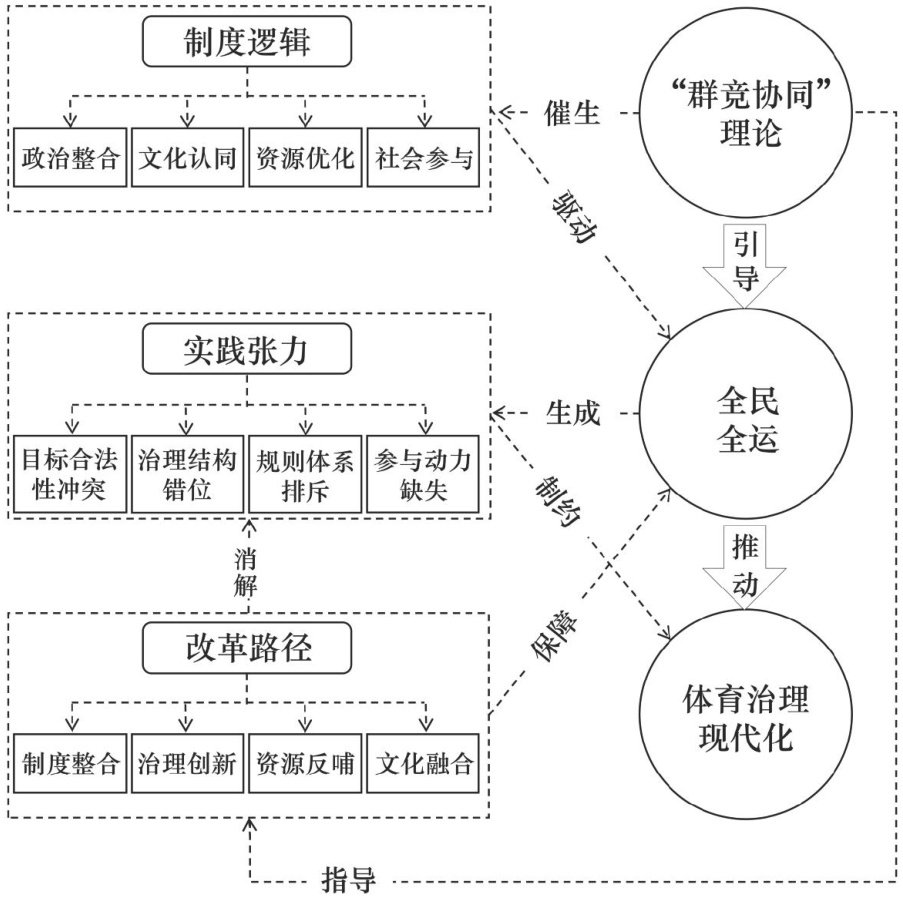
Abstract: The significant institutional shift in the governance of sports systems from a “competitive sports - centric” model to the“Qunjing Synergy” paradigm (the coordinated development of mass sports and competitive sports) is marked by the inclusion of mass sports events into the official competition framework of the 13th National Games of the People's Republic of China. this transformation not only reflects the deepening of the national fitness strategy under the context of a sports powerhouse but also underscores the institutional innovation demands for reconstructing sports publicness. Grounded in the theoretical framework of Qunjing Synergy, this study employs institutional analysis and policy document review methodologies,combining critical policy nodes and practical cases to elucidate the synergistic driving mechanisms of four institutional logics: political integration, cultural identity, resource coordination,and social participation. It further examines structural tensions in practice domains,including conflicts in value objectives, misaligned governance structures, exclusionary rule systems,and deficits in participation motivation. Findings reveal that current mass sports events face formalistic institutional embedding dilemmas, with collaborative advancement mechanisms hindered by policy implementation disengagement, rule system misalignment, and weakened stakeholder coordination. Based on these insights, the study proposes an adaptive governance framework of "institutional integration - governance innovationresource feedback-culture fusion” to provide theoretical support for optimizing the sports governance system in the new era.
Keywords: Qunjing Synergy; National Games reform; mass sports events; modernization of sport governance
在“健康中国2030”战略框架与“以人民为中心”[1]体育发展观的引领下,推动群众体育与竞技体育的深度协同,已成为新时代体育治理现代化的核心命题[2]。(剩余21208字)