双相变光伏通风墙体对室内热环境影响的数值模拟

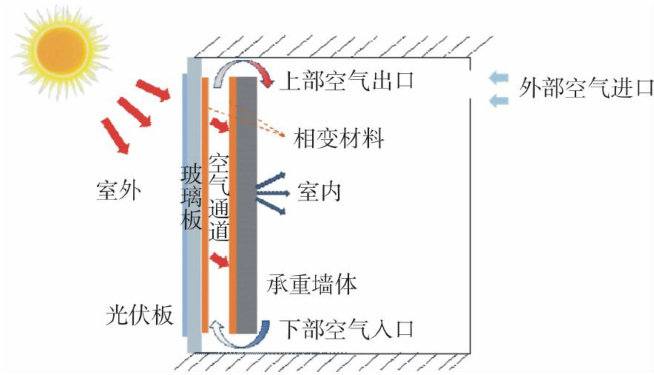
打开文本图片集
中图分类号:TB34;TU111.4 文献标志码:A 文章编号:1671-8755(2025)03-0058-08
Abstract: To enhance solar energy utilization eficiency,photovoltaic(PV)performance,and indoor thermal comfort,an innovative dual phase change - photovoltaic ventilated wall system with dual-phase change material (PCM) installed on both sides of the ventilation duct was proposed. The effects of varying air channel dimensions and PV module placement on system efciency were analyzed,and the relationship between PV efficiency and thermal comfort in hot-summer and warm-winter regions(Guangdong,China) was investigated. Simulation results indicate that optimal power generation efficiency,reaching up to 14.57% ,is achieved with an 8 cm air gap channel and the PV module centrally positioned (1O cm from both the roof and floor).Under these conditions,the average indoor temperature is 287.15 K in winter and 299.O7 K in summer. An inverse relationship between PV power generation effciency and indoor thermal comfort,assessed using the predicted mean vote (PMV)model,is observed.The dual-PCM coupled solar ventilated wall system,through precise adjustment of ventilation duct dimensions and adaptation to seasonal environmental variations,limits indoor temperature fluctuations to 0.6 C in summer,effctively mitigating temperature swings. In winter,the PMV falls below -O.5,indicating a need for further optimization of PCM properties to enhance low-temperature comfort. These findings provide a viable solution for building energy conservation in hot-summer and warm-winter regions and offer newinsights for the advancement of green building technologies.
Keywords: Solar-induced ventilation wall; Double-layer PCM;Photovoltaic efficiency;Thermal comfort
随着生活水平提高,人们对居住环境的要求也不断提升,导致建筑能耗持续增长[1]。(剩余11036字)
