基于双向时序和图卷积特征融合的脑电信号分类

打开文本图片集
EEGSignalClassificationBasedonBi-directional TimeSeries andGraph Convolutional Feature Fusion
Xu Yanjun, Li Xianhua,Du Pengfei, Zhang Kang (AnhuiUniversityofScienceand Technology,Huainan232oo1,China)
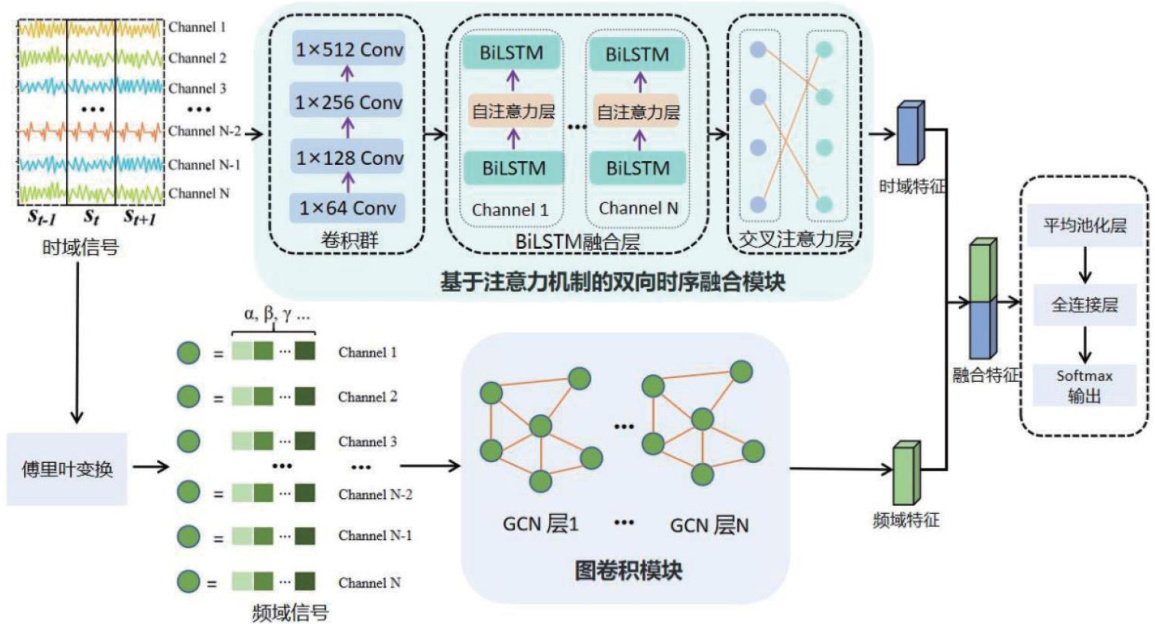
【Abstract】To enhance the synergy between time-domain and frequency-domain features in motor imagery EEG signal classification,the paper proposesatime-frequency feature fusionalgorithm basedon bidirectional temporal and graph convolutional networks.Themodel adopts adual-branch structure:the bidirectional temporal fusionmoduleextracts bidirectionalcontextual temporal features through multi-scaleconvolutional groupsandabidirectional long shortterm memory network (BiLSTM),combined with across-attention mechanism to reinforce key information;the graph convolutional moduleconstructs frequency-domain features generated from time-domain signals viaFourier transform intoan electrode topology graph,capturing local and global frequency-domain pattrns through node neighborhood informationaggregation.The time-domainand frequency-domain features output bythetwo modules are deeplyfused and then fed into a Softmax classifier.This method achieves a classification accuracy of 81.4% on the BCI Competition IVDataset 2a, outperforming benchmark methods such as FBCSP and FBCNet by 5.2% to 13.6% .Ablation experiments validate the effectiveness ofeach module.Thecollaborative designoftheattentionmechanismandBiLSTMsignificantly improves temporal modeling capabilities,providing new insights for EEG signal analysis.
【Key words】motion imagery; electroencephalogram(EEG); graphical convolutional network; bidirectional long and short term memory networks; attention mechanism
[中图分类号]G64;06 [文献标识码]A
[文章编号]1674-3229(2025)03-0055-08
0 引言
运动想象脑电信号(MI-EEG)研究致力于构建通用的脑信号基础模型,以精确捕捉和分析脑电信号,从而深入揭示大脑工作机制。(剩余9942字)
