基于机器学习的综合预测模型用于评估神经外科术后细菌性脑膜炎的风险

打开文本图片集
【中图分类号】 R651 【文献标志码】 B 【文章编号】 1672-7770(2026)01-0085-06
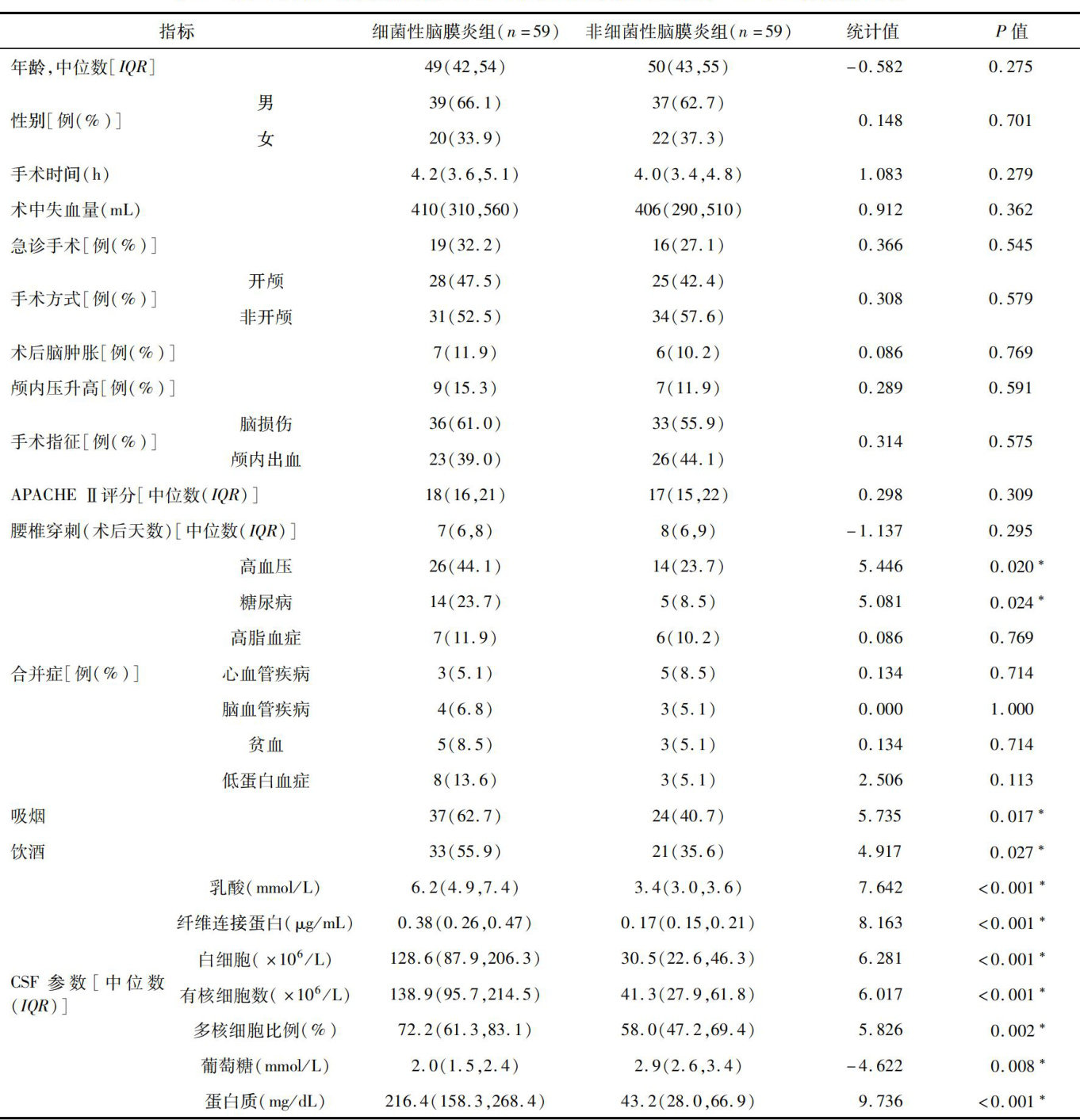
Abstract:ObjectiveTo integrate clinical and cerebrospinal fluid(CSF) features using machine-leamning algorithmsdevelopandvalidateapredictionmodelforearlyidentificationhigh-riskpatientswith posperative bacterialmeningitisafter neurosurgery.MethodsA tal 196 patients withsuspected posperative bacterial meningitisaftercraniocerebralsurgeryadmited theintensivecareunitFirstPeople'sAffliated from December 202O December 2024 were enrolledretrospectively.Demographic characteristics,comorbidities,smoking andalcohol hisry,and CSF parameters werecollected andpreprocessed using blinded procedures,encoding,and standardization.Models were developed using Extreme Gradient Boosting (XGB),Random Forest(RF),Multilayer Perceptron(MLP),and Logistic Regression(LR).Patientswere randomlysplitin a training set( n=118 )and a testing set( n=78 )ata6:4 ratio.SMOTE was applied the training set addressclassimbalance.Model performance was primarily assssd based onthe area under curve (AUC) receiver operating characteristic(ROC)and further evaluated using accuracy,F1-score,areaunder the precision-recall curve(AUPRC),and Brier score.ResultsSignificant diferences between the bacterial meningitis andnon-bacterial meningitisgroupswereobservedincomorbiditiesandlifestylefacrs(hypertension,diabetes, smoking,and alcohol consumption),aswellas CSF indices(lactate,fibronectin,whiteblood cells,protein,and glucose).Multivariable analysis identified eight independent predicrs,including hypertension,smoking,alcohol consumption,CSF lactate,CSF fibronectin,CSF white blood cels,CSF protein,and CSF glucose.Among the four models,XGBachieved thebestperformance,withanAUC0.932inthetraining setandanAUC0.968 in the testingset;the testing-setaccuracy was0.906,F1-score0.916,AUPRC0.989,and Brierscore0.07.Conclusions Comorbditiesand unhealthy lifestylehabits were closelyasociated with posperative bacterial meningitis.The XGB model icorporatingthe above clinical and CSF features demonstrated good early discriminary performance and may support posperative infection risk stratification and clinical decision-making.
Key words:neurosurgery;bacterial meningitis;machine learning;prediction model
细菌性脑膜炎是神经外科手术后常见的严重并发症,每年全球约新增120万例病例,常伴随较高的死亡率[1]。(剩余10121字)
