中国平民穿透性脑损伤的临床管理:基于低速损伤特征的实践与展望

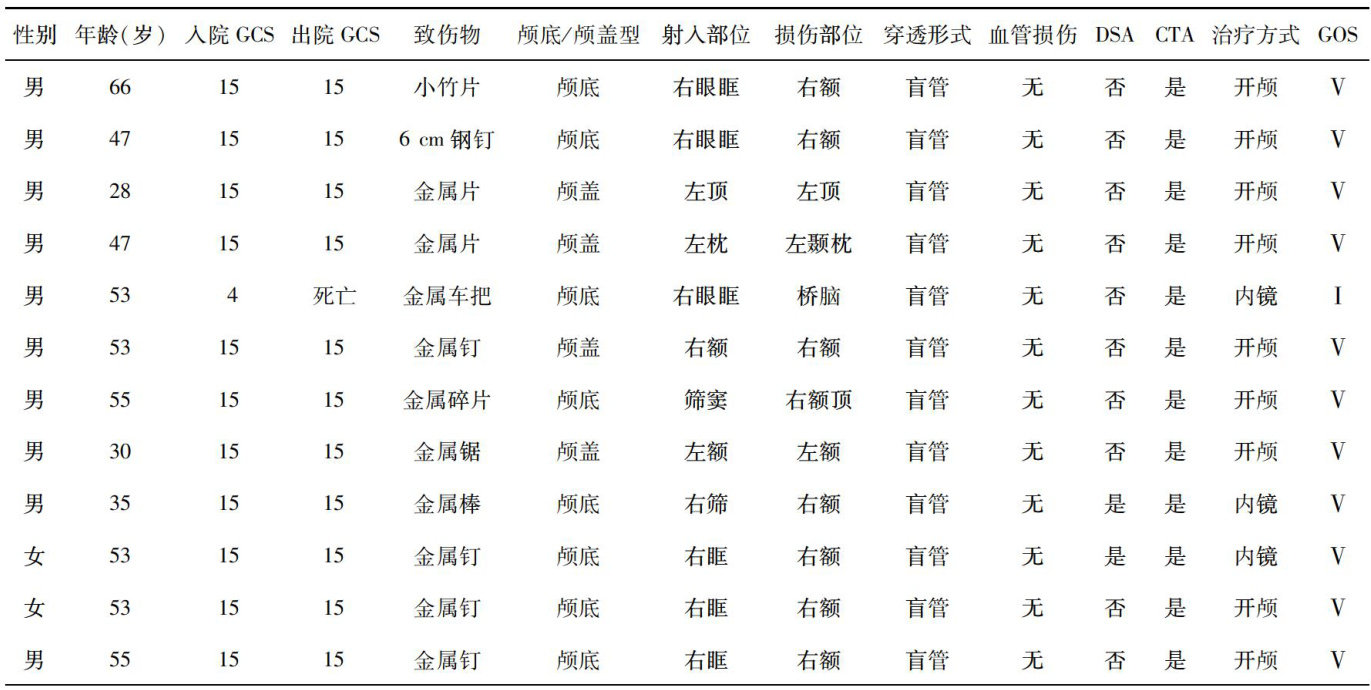
打开文本图片集
【中图分类号】 R651.1+5 【文献标志码】 A 【文章编号】1672-7770(2026)01-0001-07
Clinical management of penetrating brain injury in Chinese civilians: practice and prospects based on low-velocity injury characteristics ZHU Tongming, LI Tianwen, CHEN Kezhu, HUANG Qi,WU Jingwen,LIU Yingjun, SUN Yirui, YU Jian, ZHENG Ruizhe,WU Xuehai. Department of Neurosurgery of Huashan Hospital, Fudan University, Shanghai 2OoO4O,China Corresponding author: WU Xuehai
Abstract:ObjectiveTo investigate the clinical characteristics,diagnosis,and treatment strategies for penetrating brain injury(PBI)in China based on single-center data. MethodsThe clinical data of 18 PBI patients treated in the Department of Neurosurgery,Huashan Hospital, Fudan University from January 2O15 to November 2O25 were analyzed retrospectively,including the types of penetrating objects and injury mechanisms. Integrating the latest international evidence,this study systematically elaborated on the diagnosticand therapeutic features and challenges of PBI in China,covering aspects such as epidemiology, imaging evaluation,surgical approach selection, management of cerebrovascular complications, intracranial pressure monitoring,and precise outcome prediction. ResultsMost patients were conscious, with Glasgow Coma Scale(GCS) scores ranging from 4 to 15(mean:13.6). Penetrating objects included metal fragments and nails(12 cases), metal bullets(4 cases),a metal handlebar(1 case),and a bamboo splinter(1 case). Of these,12 cases were skull base-type injuries,and 6 were calvarial-type injuries. One case was confirmed by digital subtraction angiography(DSA) to have a traumatic pseudoaneurysm in the distal middle cerebral artery. During follow-up,Glasgow Outcome Scale(GOS) scores were Grade IV in 1 case and Grade ΔV in 16 cases. One patient died due to severe intracranial infection. ConclusionsPBI in China is characterized predominantly by low-velocity,non-firearm-related injuries. The injury mechanisms,treatment strategies,and clinical outcomes significantly difer from the high-velocity firearm injury model commonly seen in Western countries. An individualized treatment approach under a multidisciplinary team is recommended,providing a theoretical basis for establishing localized clinical practice guidelines.
Key words : penetrating brain injury; low-velocity injury ;non-firearm injury; cerebrovascular complication
全球范围内,穿透性脑损伤(penetratingbraininjury,PBI)因其高死亡率(可大于 44% )而备受关注[1-2]。(剩余7541字)
