平喘宁方通过调控HMGB1/Beclin-1轴介导的自噬改善患寒哮证大鼠的气道炎症

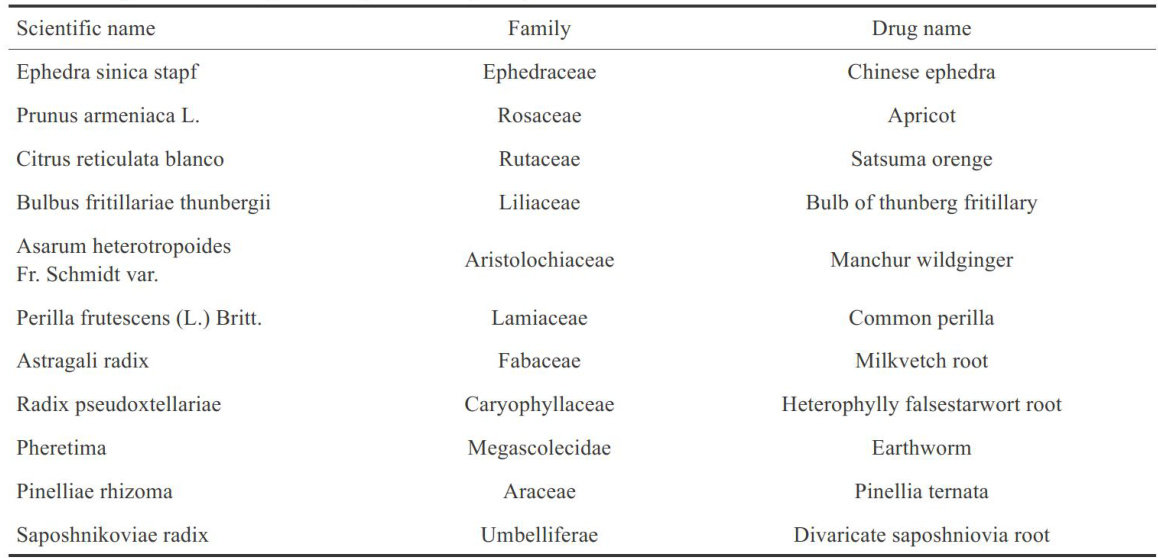
打开文本图片集
Abstract:ObjectiveToexplore themechanismofPingchuanningFormula (PCN)forinhibitingairwayinflammationinrats withasthmaticcold syndrome.Methods Atotalof105SDrats wererandomizedequallinto7groups,includingacontrol group,an asthmaticcold syndrome model group,3PCNtreatment groupsat high,mediumand low doses,a Guilong Kechuanning (GLCKN)treatmentgroup,andadexamethasone (DEX)treatment group.Inallbut thecontrolrats,asthmacold syndrome models were establishedanddaily gavageofsaline,PCN,GLCKNorDEXwasadministered 29daysafterthestart of modeling.Thechangesingeneral condition,lung functionandlung histopathologyof theratswereobserved,and inflammatory factors in the alveolar lavage fluid (BALF),oxidative stres,lung tissue ultrastructure,cytokine levels,and expresions of the genes related to the HMGB1/Beclin-1axisandautophagy wereanalyzed.Results Theratmodels had obviousmanifestationsofasthmaticcoldsyndromewithsignificantlydecreasedbodymas,foodintakeandwateritake, reduced FEV0.3′ FVC,and FEV0.3/FVC, obvious inflammatory cell infiltration in the lung tissue,and increased alveolar inflammationsoreandcountsofneutrophilsosinophils,lymphocytesmacropagesndleukoctesintheFerat modelsalsohadsignificantly increasedMDAleveland decreased SODleveland exhibitedobviousultrastructuralchanges in the lungissues,hereheexpressionsofHG1,eclin-1,G5, ⋅α, IL-6,IL-1β,and IL-13 and theLC3II/I ratio were increased,while thelevelsof Bcl-2and IFN- γ were decreased. PCN treatment significantly improved these pathological changesintheratmodels,anditstherapeuticeffectwas betterthanthatofGLKCNandsimilartothatofDEX. Conclusion PCNcan effectivelyalleviate airway inflammationinratmodelsofasthmaticcoldsyndrome possibly by modulating the HMGB1/Beclin-1 signaling axisto suppress cell autophagy, thereby attenuating airwayinflammatory damages.
Keywords:bronchialasthma;PingchuanningFormula;cell autophagy;lungfunction;airwayinflammation; asthmaticcoldsyndrome
支气管哮喘(以下简称“哮喘"是一种以气道慢性炎症、气道高反应性、可逆性气流受限和气道重塑为主要特征的慢性肺系疾病,其发病机制与环境及遗传因素有关,主要表现为喘息、气促、胸闷和(或)咳嗽等症状[2]。(剩余16904字)
