烟草野火病的绿色防控与健康管理对策

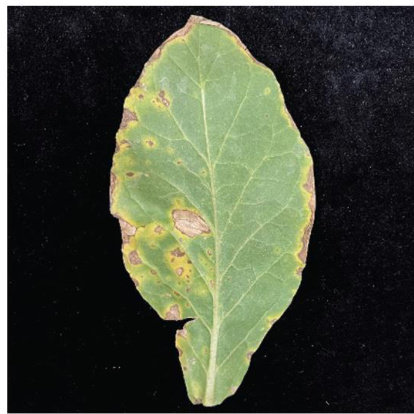
打开文本图片集
中图分类号:S432.4 文献标识码:A文章编号:2097-1354(2025)05-0046-09
Abstract: Tobacco wildfire disease is a bacterial leaf disease infection caused by Pseudomonas syringae pv. tabaci. As a critical bacterial disease in tobacco cultivation, the pathogen infects plant tissues,leading to systemic damage. The disease is typically characterized by the appearance of yellowish-brown necrotic spots surrounded by yellow halos on the leaves. Infected tobacco leaves exhibit significant deterioration in physicochemical properties during the curing process,such as increased brittleness and reduced commercial usability, posing a serious threat to the tobacco industry. This article elaborates on research related to field symptoms,microbial community analysis,and integrated management of tobacco wildfire disease. It finds that the most commonly used control methods in recent years include chemical control, biological control,and the breeding of disease-resistant varieties. However,chemical control faces issues such as pesticide residues and the development of resistance,while biological control,although environmentally friendly,but has not yet achieved mature industrial application of biocontrol agents.Although progress has been made in breeding disease-resistant varieties, but no stable, highly resistant varieties have been developed. Future research could focus on establishing region-specific green control systems based on local conditions,developing rapid detection methods using molecular detection technologies for early disease forecasting,and strengthening studies on the genetic diversity of the pathogen and control methods. These efforts willprovide more data support for formulating comprehensive strategies to manage tobacco wildfire disease.
Key words: tobacco wildfire disease; green control; biological control; disease-resistant varieties
丁香假单胞菌(Pseudomonas syringae)是一种革兰氏阴性细菌,能够通过种子、水、昆虫和被感染的植物残体传播。(剩余12389字)
