高速动力集中型动车组隧道压力波研究

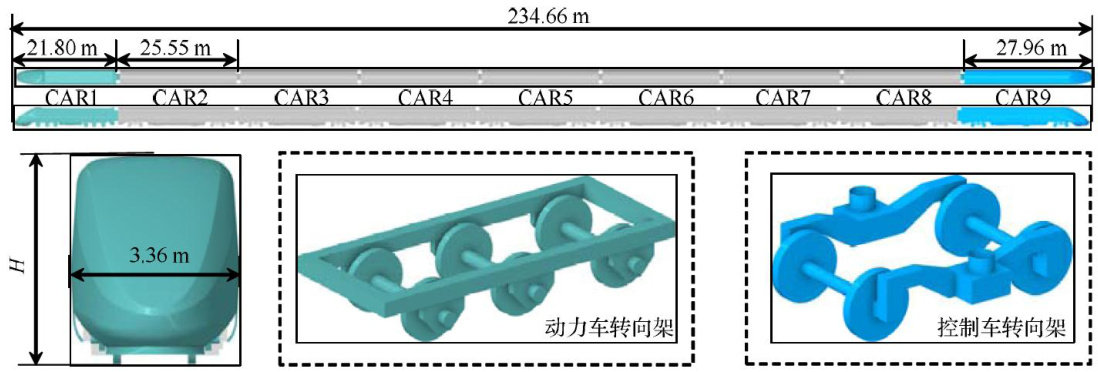
打开文本图片集
中图分类号:U237 文献标志码:A文章编号:1006-0316(2026)01-0036-07
Abstract: To evaluate the adaptability of higher-speed power-concentrated electric multiple unit trains to tunnel lines,it is essential to investigate tunnel pressure wave phenomena. In this study,a Delayed Detached Eddy Simulation model coupled with a dynamic mesh technique was employed to simulate a 9-car formation power-concentrated EMU passing through tunnels of varying cross-sectional areas and lengths. The analysis focuses on the evolution of aerodynamic loads acting on the train during tunnel entrance,transit, and exit. The results indicate that, compared with operation at 200kmh , a reduction in train speed to 160kmh combined with an increased blockage ratio leads to a significant decrease in aerodynamic load magnitudes across allcars.This effect is particularly pronounced for the tail car,where theaerodynamic drag,lateral force,and yawing moment decrease by 3.58kN , 4.5kN ,and 45.68kN⋅m ,respectively. During tunnel traversal, the wall confinement intensifies vortex formation withinthe limited tunnel space,resulting in high-intensity vortices.Thismanifests as increased aerodynamic side force and yawing moment amplitudes toward the rear of the train, with the tail car experiencing increases of 285.23% and 745.11% ,respectively, relative to the head car. Furthermore, frequency spectrumanalysis reveals thatthe dominant frequencyof the lateral aerodynamic load onthe tailcarfals within the 0.5-1.5Hz range,which corresponds closely to the suspension mode frequencies of the vehicle. This suggests a potential risk ofresonance that may compromise ride stability.This study provides critical theoretical insights into theaerodynamic behavior of EMUs during tunnel passage,ofering valuable references for the design ofboth trains and tunnel infrastructure.
Key words : trainaerodynamics;tunnel aerodynamic characteristics;numerical simulation
随着高速铁路技术的发展,高速列车已成为一种长途运输的主要工具。(剩余6341字)
