气候变化背景下特有种米蒿的分布格局及其空间迁移预测

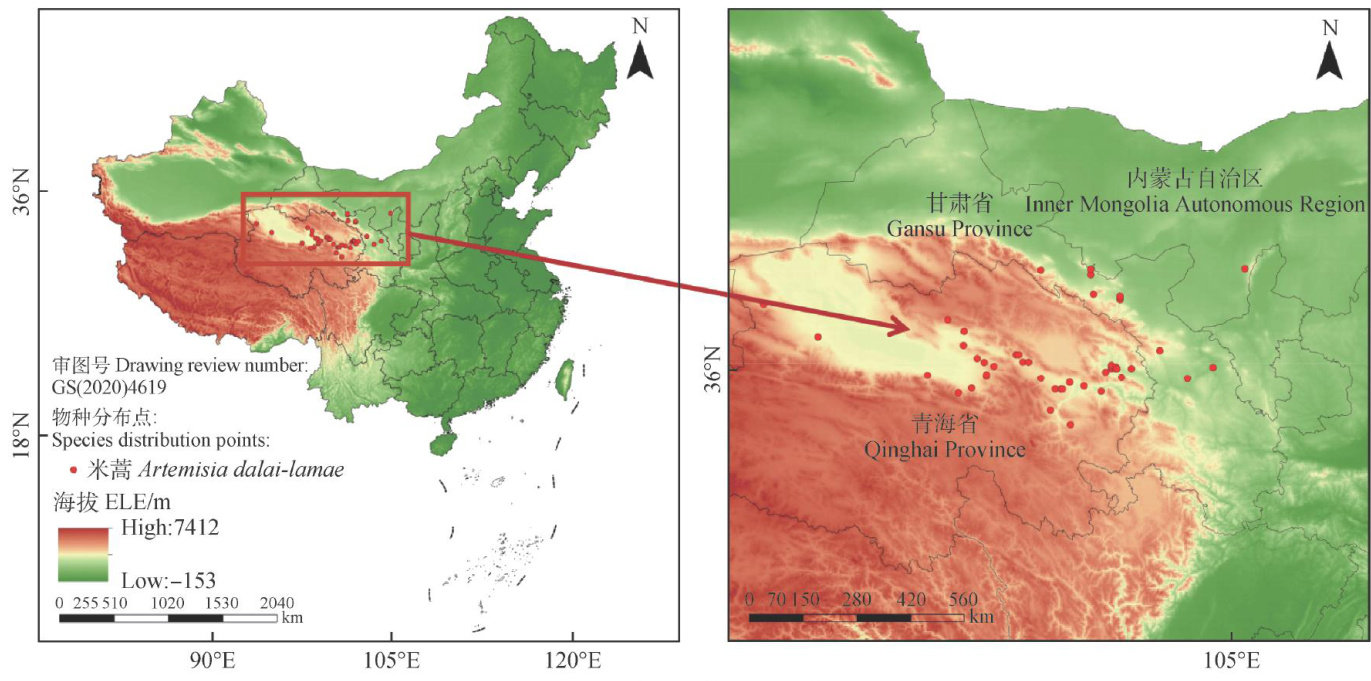
打开文本图片集
中图分类号:S812 文献标识码:A 文章编号:1007-0435(2026)01-0217-14
Abstract:To investigate the responses of distribution patterns of the endemic species Artemisia dalai-lamae in China to future climate change,this study utilized a parameter-optimized MaxEnt model with specimen data and environmental variables. The distribution patterns and centroid shifts of A . dalai-lamae under current and future(2021—2O6O)climate scenarios across three representative pathways were predicted.The results indicate that when the Regularization Multiplier(RM) was set to 3and the Feature Combination(FC) configured as linear,quadratic and hinge (LQH),the model achieved the lowestcomplexity and overfiting while maintaining high predictive accuracy. The primary environmental factors influencing the distribution of A . dalai-lamae were elevation,annual precipitation,precipitation of warmest quarter,and annual mean temperature.Under current climate conditions,the suitable habitat area for A . dalai-lamae spans 122.93×10⁴km2 ,with optimal distribution concentrated between the eastern sections of the Qilian and Kunlun Mountains.Under future climate scenarios,the suitable habitat area is projected to significantly decrease (with a maximum reduction of 43.2% ),and the distribution centroid shows a northwestward shift toward higher latitudes and elevations.
These findings suggest that future climate warming poses a severe threat to the survival of A . dalai-lamae. Key words:MaxEnt model;Climate change;Suitable distribution area;Artemisia dalai-lamae;Endemic speci
气候变化是影响生物多样性和物种分布的关键驱动力之一[1]。(剩余26507字)