用于建筑能耗预测的多尺度可解释时序预测网络模型

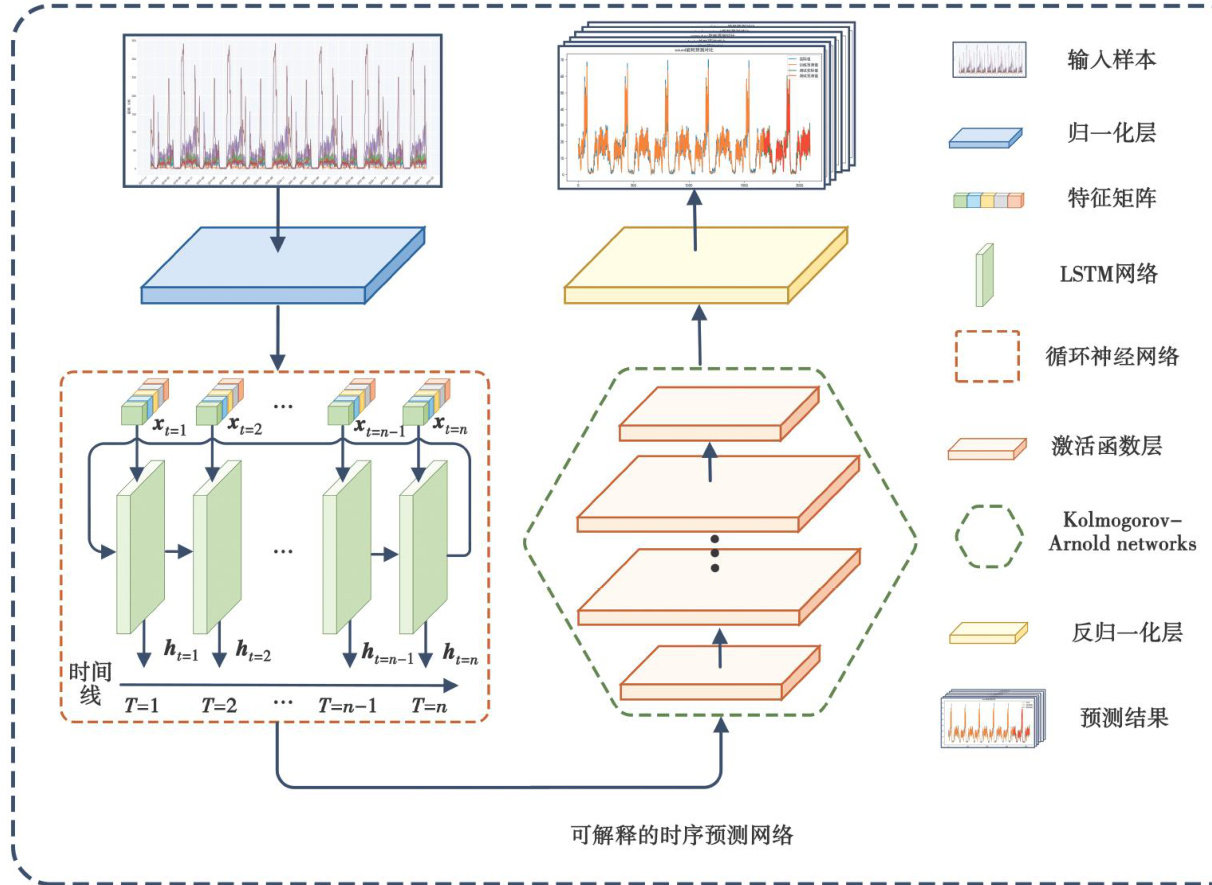
打开文本图片集
中图分类号:TM715 文献标志码:A 文章编号:1000-582X(2026)04-026-11
doi:10.11835/j.issn.1000-582X.2026.04.003
Multi-scale interpretable temporal prediction network for building energy consumption forecasting
YANG Liejuan ,TAN Guopeng',CAO Qi',YANG Huiyue',ZHOU Yang
(1.JointLogistic SupportForce UniversityofEnginering,Chongqing 401331,P.R.China;2.Unit 78156of the
Chinese People’sLiberation Army,Chongqing 40o039,P.R.China; 3.Chongqing Construction Science Research Institute Co.,Ltd., Chongqing Design Group Co. Ltd., Chongqing 400042,P.R.China)
Abstract:Accurate forecasting of building energy consumption is crucial for optimizing energy management, reducing operational costs,and achieving carbon neutrality goals.This study proposes a multi-scale interpretable temporal prediction network model (ITSFN),which enhances prediction accuracy and reliability through the collaborative optimizationof long short-term temporal (LSTM) networksand Kolmogorov-Arnold networks (KAN).The model integrates temporal-environmental feature decoupling with a dynamic attention mechanism, explicitly decomposing time-series data into seasonal,trend,andresidual components to construct a structured feature space.It employs a parallel architecture of gated recurrent units (GRU)and multi-head atention to model multi-scale features.Tested on an energy consumption dataset from a university building in a hot-summer/coldwinter region,ITSFN outperforms traditional models: it reduces the root mean square error (RMSE) of total energy consumption prediction by 13.9% compared to LSTM and decreases the RMSE of sub-item energy consumption prediction by 31.1% compared to Transformer. Additionally, ITSFN enhances the noise suppression coefficient to0.89 through feature decoupling,achieves a local attention angle of 0.92 in mutation regions,and reduces over-smoothing by 29.6% compared to traditional methods.By quantifying feature contributions, the model reveals theevolutionary patterns of component weights,further validating its efctivenessand practical applicability.
Keywords: interpretable temporal prediction; feature decoupling; hybrid attention mechanism; long short-term memory (LSTM); Kolmogorov-Arnold network (KAN)
建筑能耗是中国能源消耗总量的主要来源之一,主要有空调系统、照明系统、运维设备与其他设备等消耗形式。(剩余11986字)