基于改进自抗扰控制的高空风机叶片打磨机器人被动柔顺控制方法研究

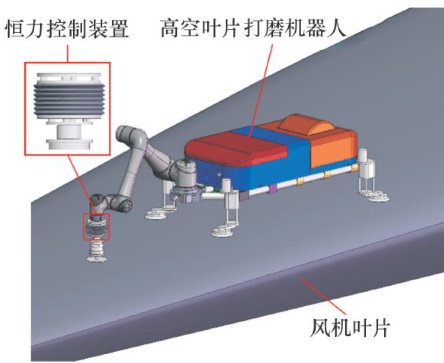
打开文本图片集
关键词:自抗扰控制;机器人打磨;柔顺控制;气动系统建模;风机叶片中图分类号:TP273;TP242;TM315DOI:10.3969/j.issn.1004-132X.2025.08.018 开放科学(资源服务)标识码(OSID):
Abstract:To cope with unknown disturbances at high altitudes and maintain a constant contact forces at the end of a high-altitude wind turbine blade repair robots during polishing,a passive compliant control algorithm was proposed based on an improved ADRC approach. The algorithm combined dead-zone compensation and gravity compensation algorithms, fully considering issues such as gas compressibility in the pneumatic systems,characteristics of electrical proportional valve dead zones,changes in tilt angle during polishing processes,and unknown disturbances during high-altitude operations. A tracking differentiator was utilized for excessve input signals,a state observer was employed to monitor system disturbances,and compensated through a state error feedback control law.By establishing the mathematical model of the control systems and conducting simulation analysis,it is found that this control algorithm improves both force control performance and response speed compared to the traditional proportional-integral-derivative (PID)algorithm. An experimental platform was constructed to conduct experiments under various operating conditions. The experimental results show that the control algorithm systems achieve 44.6% to 51. 4% reductions in settling time,a decrease in the absolute maximum error by 45.4% to 69.4% ,and reductions in mean square error by 56.5% to 91.2% .Therefore,this algorithm demonstrates improved dynamic response performance and force control accuracy,along with strong disturbance rejection capabilities and robustness,providing a theoretical foundation for practical engineering applications.
Key words:active disturbance rejection control(ADRC);robot polishing;compliant control; pneumatic system modeling;wind turbine blade
0 引言
风能是一种可持续的绿色能源,随着全球新能源产业的飞速发展,风电装机容量不断增加,风机设备的维护愈来愈重要[1]。(剩余14946字)
