中亚造山带中南部索伦缝合带岩石圈结构及其对古亚洲洋演化的制约

打开文本图片集
中图分类号:P631.4;P542 文献标志码:A
Abstract: The Central Asian orogenic belt (CAOB),which experienced ~800 Ma of subduction - accretion associated with the Paleo-Asian Ocean,represents one of the largest and most complex accretionary orogenic systems on Earth. It records key geological processes, including oceanic subduction,crustal accretion,and subsequent tectonic overprinting,thus provides a crucial window for investigating Phanerozoic continental evolution within the Paleo-Asian Ocean tectonic domain. The Solonker suture,located in the south-central segment of the CAOB,records the evolution and final closure of this ocean and is widely regarded as its terminal suture. However,the eastward extension of this suture and the subduction polarity of the Paleo-Asian Ocean in this region remain subjects of significant debate. In recent years,two deep seismic reflection profiles of large dynamite shots have been developed across the Solonker suture,extending the detection depth to the lithospheric mantle and successfully revealing the seismic structural characteristics of fossil subduction zones beneath the suture. This study synthesizes and contrasts the seismic structures imaged by these two profiles and integrates them with newly acquired geophysical datasets to characterize the lithosphere-scale deformation architecture of the study area. The combined geological and geophysical evidence demonstrates that the Paleo-Asian Ocean underwent divergent double subduction in the south-central CAOB,culminating in its final closure along the Solonker - Tuquan between the Hegenshan and Xar-Moron sutures,with its eastern extension reaching into the central Songliao basin.
Key Words: Central Asian orogenic belt;Paleo-Asian Ocean; lithospheric structures; Solonkersuture; fossil subduction zone
0 引言
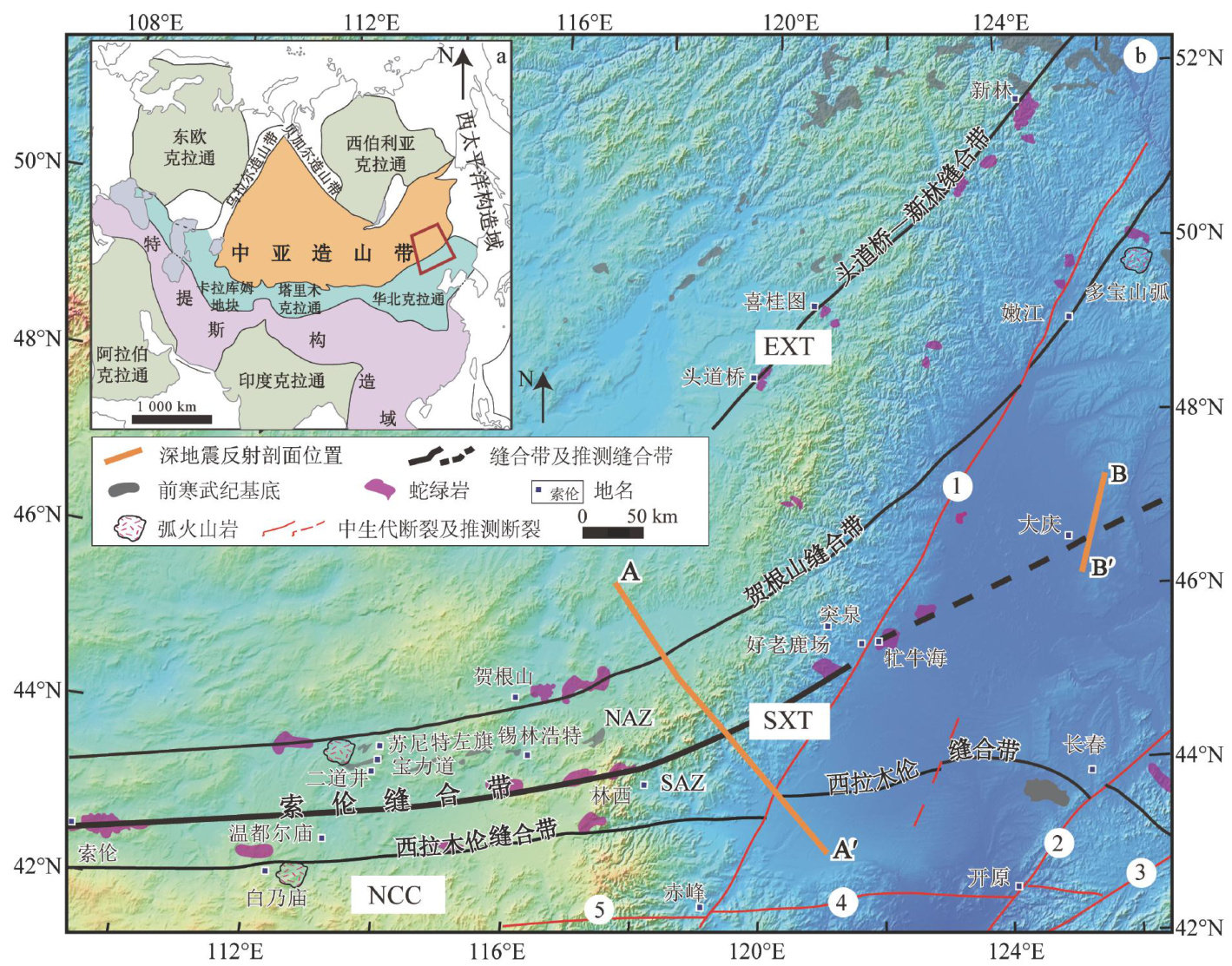
中亚造山带(又称北方造山带)西起里海,东抵西太平洋,绵延超过 5500km ,广阔分布于西伯利亚、东欧、塔里木与华北等主要克拉通之间,是全球规模最大的显生宙增生型造山带[1-4]。(剩余18804字)